
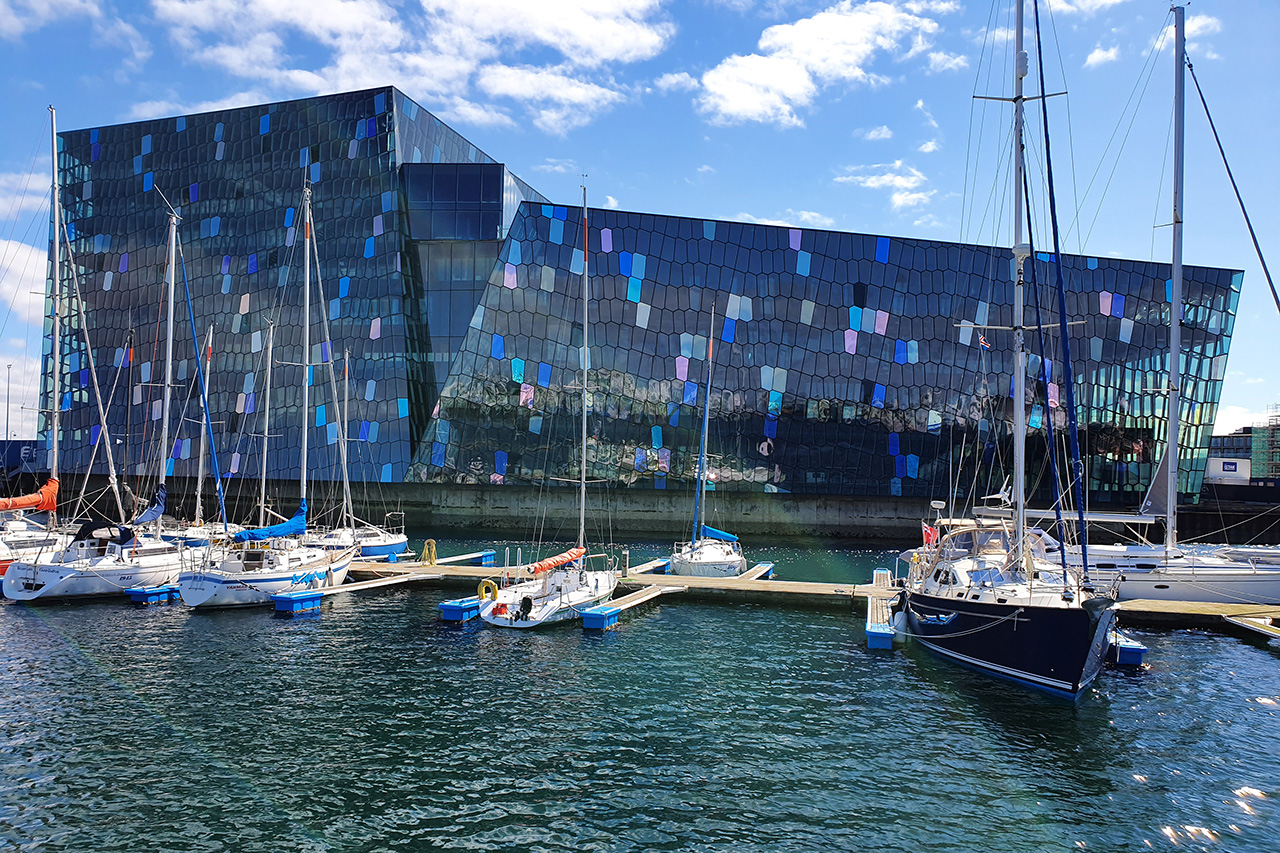
There are buildings you visit, and then there are buildings that change the way you see a city. Harpa Concert Hall does the latter. Sitting on Reykjavík’s waterfront where the city meets the North Atlantic, it’s a structure that somehow manages to look like it grew out of the Icelandic landscape and landed from the future at the same time.
Glass, Light, and Basalt Logic
Harpa’s appearance is the first thing that stops you. The south-facing façade is a wall of geometric glass panels — thousands of them, each uniquely shaped and coloured — arranged in a pattern that borrows its logic from Iceland’s basalt columns. The design is a collaboration between Danish firm Henning Larsen Architects and Icelandic-Danish artist Ólafur Elíasson, and it does something unusual: it makes the building behave differently depending on when you look at it.
On a bright summer afternoon, the panels fracture sunlight into shifting colours that move across the surface as the hours pass. Under heavy winter cloud, the glass turns moodier, pulling greys and blues from the sky and harbour water. At night, with interior lighting activated, the whole structure glows like a lantern on the waterfront. It’s a building that never quite looks the same way twice, which feels appropriate for a country where the weather can cycle through four seasons before lunch.
The glass isn’t just decorative. It captures and refracts sunlight to warm the interior during Iceland’s darker months — one of several sustainable design choices, alongside geothermal heating and natural light optimisation, that reflect how seriously Iceland takes its environmental commitments.
Built Through a Crisis
Harpa’s story is inseparable from a difficult chapter in Iceland’s recent history. Construction began in 2007, and a year later the country’s financial system collapsed. The project suddenly looked like an extravagance a small nation couldn’t afford, and there were real questions about whether it would ever be finished.
It was. The Icelandic government and the City of Reykjavík pushed the project through to completion, and Harpa opened its doors in May 2011. The final cost came to approximately 164 million euros and four years of construction. The decision to finish it — using local materials and Icelandic expertise wherever possible — turned Harpa into something more than a concert hall. It became a statement about what the country chose to protect when everything else was falling apart. That context still clings to the building. It’s hard to stand inside it without sensing that this place means something beyond its function.
What Happens Inside
Harpa is the home of both the Iceland Symphony Orchestra and the Icelandic Opera, which gives the building a musical heartbeat that runs year-round. The main hall, Eldborg, is an acoustic marvel — adjustable reverberation chambers and advanced sound diffusion systems allow it to shift character depending on what’s being performed, whether that’s a full orchestral programme or a rock concert.
And the range is genuinely wide. Harpa has hosted Björk, Sigur Rós, and Laufey alongside international touring acts, jazz ensembles, theatre productions, conferences, and local art exhibitions. It’s a venue that refuses to be boxed in by genre, which mirrors something about Reykjavík’s cultural personality — a city of 130,000 that punches absurdly above its weight in music, art, and design.
Beyond the performance halls, the ground floor functions as a kind of public square. People drift in to eat, browse the shops selling Icelandic design and souvenirs, or simply sit and look up at the glass ceiling fractalling light across the interior. There’s a high-end restaurant and a more casual café, both leaning into Icelandic ingredients. Families come for interactive music workshops and educational tours. Tourists wander in off the harbour path. Locals meet for coffee. It’s one of those rare cultural buildings that doesn’t feel like it’s holding you at arm’s length.
The Waterfront Around It
Harpa’s position on the harbour means it sits at the intersection of several things worth seeing on foot.
The Old Harbour is steps away — a working port area that’s evolved into one of Reykjavík’s more interesting neighbourhoods, mixing whale-watching departure points with independent cafés, seafood restaurants, and small galleries. Walking east along the waterfront brings you to the Sun Voyager, Jón Gunnar Árnason’s stainless steel sculpture evoking a Viking longship, framed against the broad shoulders of Mount Esja across the bay.
Inland, Reykjavík’s compact downtown grid is a short walk in any direction — the National Gallery, the Reykjavík Art Museum, and the independent shops and restaurants along Laugavegur are all within easy reach. And rising above it all to the south, the distinctive spire of Hallgrímskirkja anchors the skyline.
Harpa ties these things together. It’s the point on the waterfront where the cultural, the architectural, and the everyday overlap in a way that feels natural rather than curated.
Why It Matters
Iceland is a country of around 380,000 people on a volcanic island in the middle of the North Atlantic. By most conventional measures, it has no business producing a building like Harpa — a structure that won the European Union Prize for Contemporary Architecture in 2013 and regularly appears on lists of the world’s most striking concert halls.
But that’s exactly why it fits. Harpa is an expression of the same impulse that drives Icelandic music, literature, and design: the conviction that isolation and scale are no excuse for small ambitions. It was built during the worst economic crisis in the country’s modern history, finished with local hands and local materials, and opened as a space that belongs as much to the person wandering through its lobby on a Tuesday afternoon as to the orchestra performing in Eldborg on a Saturday night.
It’s a concert hall, yes. But spend any time around it and you’ll realise it functions as something closer to a living room for the city — a place where Reykjavík gathers, performs, eats, argues about architecture, watches the light change on the harbour, and quietly reminds itself what it decided to build when it had every reason not to.